What Common Grow Light Placement Error Drastically Cuts Hydroponic Harvests?
Hydroponic grow light placement is often treated as a simple question of how many inches separate a fixture from the leaves. That shortcut is the problem. A light can look bright, sit at a seemingly sensible height, and still deliver too little useful light to the outer half of a hydroponic canopy—or deliver an unnecessarily intense hotspot directly beneath the fixture. In both cases, the issue is not merely where the lamp hangs. It is the pattern of light arriving at the leaves over time.
The common mistake is setting the fixture height once and then judging the setup by visual brightness instead of measuring or reasoning about canopy-level intensity and coverage. Oklahoma State University Extension distinguishes the amount of light a fixture produces from PPFD, the amount reaching a particular surface, and notes that LED placement depends on the plant, fixture type, coverage area, environmental conditions, and distance from the canopy. r1
The placement error that quietly shrinks the harvest
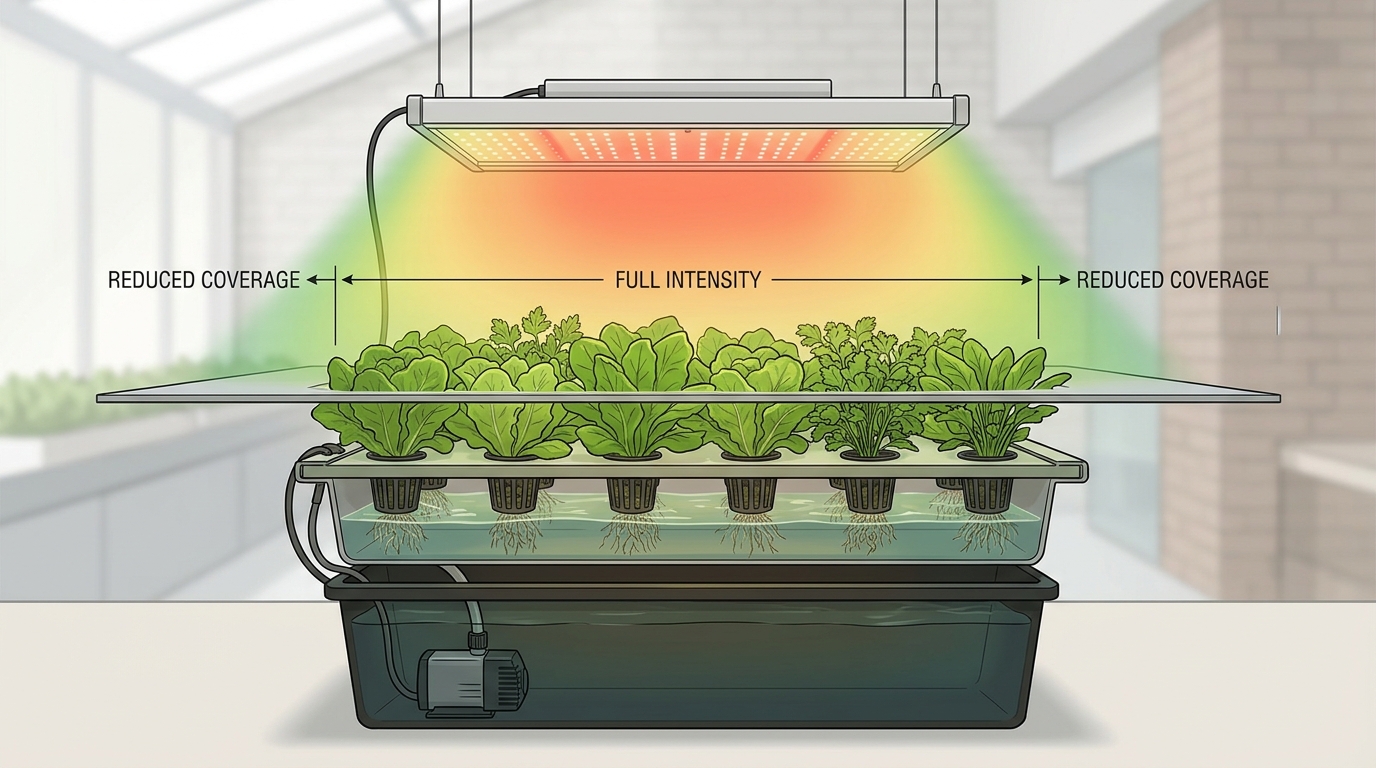
Imagine a rectangular raft of lettuce under one overhead fixture. The grower lowers the light until the center leaves look intensely illuminated. The plants appear compact, so the setup seems successful. But if the fixture's useful light is concentrated in the middle, plants around the perimeter may receive substantially less. The grower then sees slower growth at the edges, smaller leaves, or uneven harvest maturity and may blame nutrients, water circulation, or plant spacing.
The opposite mistake is also common: raising the light because the fixture is powerful or because the leaves seem close to it. Raising a light increases the area it can cover, but it also reduces the intensity received at the canopy. A setup can therefore trade a severe center hotspot for a uniformly weak crop. Neither extreme is solved by a universal height recommendation.
This matters because photosynthesis responds to the quantity of photosynthetically useful photons arriving at the leaf surface. PPFD is expressed in micromoles of photons per square meter per second. Daily light integral, or DLI, adds the time dimension by describing the accumulated photon exposure over a day. A grower who considers only fixture height is therefore ignoring at least two important variables: how much light reaches the leaves and how long they receive it.
Why distance changes the light environment
Light spreads as it travels away from a source. For an idealized point source, intensity decreases approximately with the square of distance. Real horticultural fixtures are not perfect point sources, and LED panels, bars, optics, reflectors, and diffusers change the distribution. Still, the underlying lesson is useful: small changes in distance can produce meaningful changes in intensity, while also changing coverage.
Consider a simplified example. If a particular light distribution produced a certain intensity at 12 inches, moving the same source substantially farther away would not simply make the whole canopy proportionally dimmer. The beam also spreads over a larger area. Conversely, bringing it very close can raise the center intensity while reducing the margin for uniform coverage.
That is why “keep the light X inches above the plants” is incomplete advice. Two fixtures suspended at the same height can produce very different canopy patterns. Two crops under the same fixture can also require different positioning because their canopies differ in size, density, and developmental stage.
University guidance reinforces this principle from another angle. Oklahoma State notes that placement involves both distance from the plant canopy and spacing between lighting units, and recommends an even spread across the growing space rather than treating one point beneath the lamp as the entire target. r2
PPFD is more useful than judging brightness by eye
Human vision is a poor substitute for plant-level light measurement. A room can appear brilliantly lit while a crop receives an inadequate photosynthetic photon flux. Conversely, a fixture that looks modest to a person can create an intense zone directly below it.
PPFD solves part of that ambiguity because it describes photons arriving at a defined surface. In practical hydroponics, that surface should be the plant canopy, not the floor, reservoir lid, or an arbitrary point in the air. Oklahoma State University Extension specifically explains that PPFD measures the amount of light reaching a given surface and identifies it as a more relevant plant-production measure than ordinary brightness units for LED horticultural applications. r3
This creates a useful troubleshooting rule:
- If the center and edges have very different PPFD readings, prioritize uniformity and coverage before simply increasing total intensity.
- If readings are consistently low across the entire canopy, consider whether the fixture is too high, the output is insufficient, the photoperiod is too short, or another environmental factor is limiting growth.
- If the center is very intense while the edges are weak, lowering the fixture may make the center problem worse even if the average-looking brightness improves.
- If the canopy has grown upward since the last measurement, reassess the light at the new canopy height rather than assuming the original setting still applies.
The key distinction is between light output and light delivered to the crop. A fixture's rated output cannot tell you exactly what every leaf receives once mounting height, beam spread, crop geometry, reflections, and neighboring fixtures enter the picture.
Growth stage changes the correct answer
A seedling, a young vegetative plant, and a mature harvest canopy are not the same lighting problem. The canopy becomes larger and taller, leaves overlap differently, and the crop's ability to use additional light can change with developmental stage and the rest of the growing environment.
Utah State University Extension gives an example of approximately 200–400 µmol/m²/s as a typical PPFD range for seedlings. r4 That should not be interpreted as a universal target for every hydroponic crop. It illustrates the more important principle: stage-specific light requirements exist, so a placement setting that works for young plants should not automatically be carried unchanged into later growth.
Recent peer-reviewed work on hydroponically grown lettuce makes the same issue more concrete. A 2026 study compared fixed and changing PPFD treatments and reported greater shoot fresh and dry mass when fixed PPFD increased from 150 to 350 µmol m−2 s−1 under its experimental conditions. The study also found that some staged increases produced comparable biomass with better light-use efficiency than a fixed high-light treatment. r5
The important takeaway is not that every grower should copy those exact numbers. The experiment used a specific lettuce cultivar, spectrum, temperature, humidity, photoperiod, nutrient environment, and controlled setup. Instead, it demonstrates why a crop's lighting strategy can change during development and why “more light all the time” is not automatically the most efficient solution.
Three decisions that should come before moving the fixture
First decision: Is the problem intensity or uniformity? If the whole canopy is underexposed, the solution is fundamentally different from a canopy where the center is intense and the edges are weak. A center-versus-edge comparison can reveal this quickly.
Second decision: Has the canopy changed? If plants have grown several inches upward or outward, the old measurement no longer describes the current crop. Recheck from the leaf surface rather than from the shelf, reservoir, or fixture frame.
Third decision: Is light actually the limiting factor? Light is important, but it does not override temperature, carbon dioxide availability, water movement, root-zone conditions, or nutrition. If the canopy already receives an appropriate light environment and growth remains poor, increasing intensity can waste energy or introduce additional stress without fixing the underlying problem.
These decisions produce a simple logic chain: if the entire canopy is dim, investigate intensity and exposure time; if only parts are dim, investigate coverage and fixture arrangement; if light is already adequate, investigate another growth limitation before increasing light.
A practical way to reset hydroponic light placement
- Define the actual crop area. Mark the rectangle or footprint occupied by leaves, not merely the footprint of the hydroponic tray. Include the plants around the perimeter because they are often where uneven coverage becomes visible first.
- Measure at canopy height. If a suitable light meter or quantum sensor is available, take readings where the leaves are growing. Avoid using a single center reading as the complete description of the lighting environment.
- Sample the center and edges. For a rectangular crop, compare at least the center with several outer positions. A larger canopy warrants more measurement points because a single number can conceal a large gradient.
- Look for a pattern before changing height. A strong center with weak edges suggests a distribution problem. Low readings everywhere suggest an overall exposure problem. A sharply elevated hotspot can suggest that the fixture is too close for the desired coverage.
- Change one variable at a time. Move the fixture or alter its output, then reassess. Simultaneously changing height, dimming, photoperiod, and plant spacing makes it difficult to determine what actually improved the crop.
- Recheck after canopy growth. Plant height and leaf area are moving targets. A setting that was balanced when the crop was small can become uneven as foliage fills the available space.
- Keep a simple record. Record canopy height, measurement locations, approximate PPFD, photoperiod, and visible plant response. The purpose is not to create laboratory-grade data; it is to prevent repeated guesswork.
This method is deliberately measurement-first. A grower without a dedicated meter can still inspect for obvious gradients, compare plant morphology across the canopy, and make gradual changes. But visual inspection should be treated as evidence of a possible problem, not as a precise measurement of photon delivery.
Use coverage as a separate variable from height
One fixture can be technically powerful yet poorly matched to the shape of the crop. This happens when the fixture creates a narrow high-intensity footprint over a wide plant bed. Increasing the hanging height may improve coverage but lower intensity. Adding or repositioning fixtures can improve distribution without requiring an extreme height change.
Oklahoma State University Extension describes LED placement in terms of plant type, device type, coverage area, environmental conditions, and distance, and notes that overlapping light from multiple fixtures can help create a more even spread. r6
The practical implication is important: do not use height to solve every lighting problem. If a broad canopy has a persistent dark perimeter and an intense center, the better question may be how the light is distributed horizontally rather than whether the lamp should move another few inches upward or downward.
Reflective surfaces can also alter the environment, particularly in enclosed spaces, but they should be considered a secondary adjustment. Reflected light does not make a poor primary distribution pattern automatically correct. The canopy still needs to be evaluated where the leaves actually receive light.
Warning: avoid chasing maximum intensity
Warning: More PPFD is not a universal cure for weak harvests. Increasing intensity can raise plant demand for water and carbon dioxide and can interact with temperature, leaf temperature, nutrient status, and photoperiod. A light-related problem should be diagnosed before the fixture is simply driven closer or brighter.
Recent lettuce research illustrates why this caution matters. The 2026 hydroponic study found that higher fixed PPFD increased biomass under its experimental conditions, but it also reported reduced light-use efficiency at the higher fixed intensity. r7 In other words, more photons can produce more plant material while simultaneously producing less biomass per unit of lighting input.
There is also a biological limit to how useful additional light can be under a particular combination of environmental conditions. If another resource is limiting, additional photons may not translate proportionally into harvest. The goal is therefore not the brightest possible canopy. The goal is an appropriate and sufficiently uniform light environment that the crop can use.
Exceptions: when distance alone is the wrong diagnosis
Exception one: a naturally lit greenhouse or bright room. Artificial lighting may be supplemental rather than the sole source. In that situation, changing the fixture changes the total daily light environment, but it does not describe the sunlight contribution. A dark-looking artificial-light setting may still produce adequate total exposure if daylight is substantial.
Exception two: different crop species. Lettuce, basil, tomatoes, peppers, seedlings, and flowering plants do not share one universal lighting target. A number that works for one crop should not be copied blindly to another.
Exception three: different fixture geometry. A compact point-like lamp, a linear bar, and a broad panel can have very different distribution patterns at the same nominal distance. The fixture's physical design matters.
Exception four: heat rather than photons. If leaves are showing heat stress or the surrounding air and canopy become excessively warm, reducing distance can create a new problem even when it improves PPFD. The plant experiences the whole environment, not light in isolation.
Exception five: dense mature foliage. A top-down measurement can describe the upper canopy well while saying little about leaves lower in the plant. Interlighting and canopy architecture become relevant questions in dense crops, although the appropriate strategy depends strongly on crop type and production system.
Practical action checklist
- □ Identify the actual leaf canopy area before judging coverage.
- □ Measure or assess light at canopy height, not just at the fixture or tray.
- □ Compare the center with several edge positions.
- □ Decide whether the problem is low intensity, uneven coverage, or both.
- □ Consider growth stage before applying a single lighting setting.
- □ If the canopy has grown, reassess the fixture-to-leaf distance.
- □ Change one lighting variable at a time.
- □ Keep photoperiod in the calculation instead of focusing only on instantaneous PPFD.
- □ Check temperature and other environmental conditions before increasing intensity.
- □ Reassess the setup after significant canopy expansion.
A simple decision table for placement problems
Why the same mistake keeps returning
The persistence of this placement error comes from an understandable mental shortcut: the fixture is visible, while photons arriving at individual leaves are not. Growers can see the lamp, measure the hanging height, and observe whether a plant looks healthy. Those observations feel concrete. But the plant responds to the light environment at the leaf, integrated across time and interacting with the rest of its environment.
That distinction also explains why two visually similar hydroponic systems can respond differently to the same fixture height. One may have a compact canopy directly below the light; another may have plants spread over a larger rectangle. One may have a reflective enclosure; another may have open sides. One may be growing seedlings; another may be carrying mature foliage. The same number of inches cannot encode all those variables.
A better habit is to treat hanging height as an adjustment variable, not the final target. The target is an appropriate light environment across the crop. Height is simply one way to influence it.
Frequently asked questions
1. What is the most common grow light placement mistake in hydroponics?
The most consequential mistake is relying on a fixed hanging distance or visual brightness instead of evaluating light at canopy level. This can produce a strong center and weak edges, or a uniformly weak canopy if the fixture is too far away.
2. Is a closer grow light always better?
No. Moving a fixture closer generally increases intensity at nearby leaves, but it can reduce useful coverage and create a hotspot. If the canopy is broad, a closer fixture may make the center better while making the overall distribution worse.
3. Should I use PPFD instead of lux?
For plant-production decisions involving photosynthetic light, PPFD is generally more directly relevant because it describes photon flux density at the crop surface. Oklahoma State University Extension specifically identifies PPFD as a common horticultural measure for LED lighting. r8
4. Do seedlings need the same light intensity as mature hydroponic plants?
Not necessarily. Lighting needs can change with crop stage. Utah State University Extension, for example, discusses approximately 200–400 µmol/m²/s PPFD for seedlings as a general example, while research on mature hydroponic lettuce has examined substantially different intensities. r9
5. How often should grow light height be checked?
There is no universal calendar interval. Check whenever the canopy changes enough that the leaves are materially closer to the fixture, the crop expands toward the edges, or plant growth suggests a lighting imbalance. The more rapidly the crop grows, the more often placement should be reassessed.
6. Can I solve uneven lighting by raising the light?
Sometimes, but not always. Raising a fixture can broaden coverage while reducing intensity. If the center is strong and the edges are weak, it may help, but the correct response depends on the measured or observed distribution. Multiple fixtures or a different arrangement may provide better uniformity.
7. What if the light level seems correct but plants still grow poorly?
Investigate other constraints before increasing light. Temperature, carbon dioxide, nutrient availability, root-zone conditions, water movement, humidity, and disease can all affect growth. Lighting should not be treated as an isolated control knob.
8. Does a powerful grow light need to hang farther away?
Not automatically. Fixture power alone does not describe the canopy-level distribution. A powerful fixture may be dimmed or positioned according to the crop and coverage pattern, while a lower-output fixture may need a different placement. The relevant question is what reaches the leaves.
9. Is daily light integral more important than distance?
Distance and DLI answer different questions. Distance influences instantaneous intensity and coverage, while DLI represents accumulated daily photon exposure. A useful lighting assessment considers both intensity and duration rather than treating either one as a substitute for the other.
The better way to think about hydroponic light placement
The harvest penalty from poor placement does not usually come from one magical “wrong” number of inches. It comes from a mismatch between where the fixture sends light and where the crop needs it. A center hotspot can waste usable coverage. Excessive distance can dilute intensity across the entire canopy. A setting that worked for seedlings can become unsuitable after the foliage expands. And increasing light without checking the rest of the environment can turn a lighting correction into a new stress problem.
The most useful hierarchy is therefore straightforward: measure the canopy, evaluate uniformity, account for growth stage, consider daily exposure, and only then adjust fixture height or position. If the whole canopy is low, address overall exposure. If only the edges are low, address distribution. If light is already adequate, stop treating the fixture as the automatic cause of poor growth.
That approach turns hydroponic grow light placement from a guess about hanging height into a repeatable crop-management decision. The objective is not to make the lamp look perfectly positioned. It is to create a light environment that the plants can use consistently across the canopy and throughout the growth cycle.


Comments
Post a Comment