Why Your Automated Hydroponic System Might Be Lying to You: The Hidden Impact of Uncalibrated Sensors
An automated hydroponic system can maintain pumps, adjust nutrient dosing, regulate water temperature, and monitor growing conditions around the clock. Yet even a sophisticated setup can quietly create the wrong environment for plants. The problem may not be faulty automation software or an undersized pump. It may be a sensor reporting inaccurate information with complete confidence.
Automated hydroponic sensor calibration is essential because every automated decision depends on the accuracy of the measurements behind it. A pH sensor that consistently reads too high can trigger unnecessary acid dosing. An EC sensor that underreports nutrient concentration can encourage excessive fertilizer addition. A temperature probe that has drifted can make an otherwise intelligent controller respond to conditions that do not actually exist.
The important distinction is that automation does not automatically guarantee accuracy. A controller can follow its programming perfectly while producing poor growing conditions because its inputs are wrong. Understanding how calibration works, recognizing unreliable readings, and knowing when to intervene can help prevent gradual nutrient problems before they become visible plant damage.
The Most Important Takeaway: Automation Is Only as Reliable as Its Measurements
Hydroponic controllers operate through a straightforward feedback process: measure an environmental variable, compare it with a target, and activate equipment to correct any difference.
For example, a controller might detect that the nutrient solution has reached a pH above its programmed range. It then activates a dosing pump to introduce an appropriate pH-adjusting solution. Once the measured value returns to the target, dosing stops.
This process assumes that the sensor is measuring correctly. If the actual pH is already within the desired range but the probe reports a higher value, the controller may add an unnecessary amount of acid. The resulting solution could become too acidic even though the automation dashboard displays a seemingly successful correction.
The same principle applies to electrical conductivity and temperature. Automated systems cannot distinguish between a genuine environmental change and a misleading sensor signal unless their monitoring and verification processes account for measurement uncertainty.
Three components deserve particular attention:
- pH sensors: Measure the acidity or alkalinity of the nutrient solution and influence nutrient availability.
- EC sensors: Estimate dissolved ionic concentration through electrical conductivity and help monitor nutrient strength.
- Temperature sensors: Monitor nutrient solution or growing-environment temperature, depending on their placement.
These measurements are related, but they are not interchangeable. A stable EC reading does not prove that the pH is correct, and a reliable temperature reading does not establish that nutrient concentration is appropriate.
Why pH Sensor Drift Can Create Hidden Nutrient Problems
Hydroponic plants absorb mineral nutrients through a water-based solution. The chemical conditions of that solution influence how readily different elements remain available for root uptake.
pH describes the solution's acidity or alkalinity. Many commonly grown hydroponic crops perform within a mildly acidic range, although the preferred operating range depends on the species, growth stage, nutrient formulation, and production method.
When pH moves outside an appropriate range, certain nutrients can become less available even when they are physically present in the reservoir. This means a plant may exhibit symptoms resembling nutrient deficiency despite receiving a fertilizer solution containing the relevant elements.
An inaccurate pH probe complicates this situation because the controller may interpret the problem incorrectly.
How an inaccurate pH reading affects automated dosing
Consider a controller programmed to maintain a particular pH target. If its probe has developed a positive measurement offset, the controller may report a higher pH than the solution actually has.
The controller responds by adding pH-down solution. If this happens repeatedly, the reservoir can become increasingly acidic. Nutrient availability changes, root conditions deteriorate, and plants may eventually show signs of stress.
A negative measurement offset can produce the opposite problem. The controller may believe the solution is more acidic than it really is and introduce excessive pH-up solution.
Neither situation necessarily produces an immediate alarm. The controller may continue operating normally because it has no independent way to recognize that its primary measurement is inaccurate.
Why calibration matters
pH calibration establishes a relationship between the probe's electrical response and known reference solutions. Standard pH 7.00 and pH 4.00 buffer solutions are commonly used to check probes across an acidic operating range.
A two-point calibration can identify both an offset problem and a change in electrode response, often described as slope deterioration. Simply adjusting the displayed reading at one reference point may conceal a probe that responds poorly elsewhere in the working range.
For systems that rely on automatic acid or base dosing, this distinction is particularly important. A probe should not be considered reliable merely because it can be adjusted to display one correct reference value.
EC Sensor Accuracy: Why Nutrient Strength Can Be Misrepresented
Electrical conductivity, usually abbreviated as EC, measures how readily a solution conducts electricity. Dissolved ions contribute to conductivity, making EC a useful indicator of the overall ionic concentration of a hydroponic nutrient solution.
However, EC is not a direct measurement of every individual nutrient. It cannot independently tell a grower how much nitrogen, potassium, calcium, or magnesium is present. Two solutions with different nutrient compositions can produce similar conductivity readings.
This limitation is important when interpreting automated nutrient management systems.
What happens when an EC sensor reads too low?
Suppose a reservoir contains a nutrient solution that is already sufficiently concentrated. An EC probe with a negative offset reports a lower value than the actual conductivity.
The controller interprets the reading as insufficient nutrient strength and activates a dosing pump. Additional fertilizer enters the reservoir, increasing the actual EC even though the dashboard may continue to show an apparently acceptable value.
As the concentration increases, plants may experience greater osmotic stress. Water uptake becomes more difficult because the concentration difference between the root environment and plant tissues changes.
Excessive nutrient concentration can also contribute to nutrient antagonism, where elevated concentrations of certain ions interfere with the uptake or balance of others.
Why temperature compensation is important
Electrical conductivity changes with temperature. A warmer solution generally conducts electricity differently from a cooler solution, even when its dissolved ionic composition remains unchanged.
Many EC instruments include automatic temperature compensation. This feature attempts to account for temperature-related conductivity changes and express the reading at a reference temperature.
However, temperature compensation does not repair an inaccurate temperature measurement, an incorrect compensation setting, or an unsuitable calibration reference.
For consistent monitoring, verify that the EC meter's temperature compensation method is appropriate for the instrument and solution. Avoid assuming that two EC readings taken at different temperatures are directly comparable without understanding how each instrument handles compensation.
Temperature Sensors: The Quiet Influence on Root Health and System Stability
Temperature measurements are sometimes treated as less important than pH and EC because they do not directly describe nutrient concentration. In practice, they influence several biological and chemical processes.
Nutrient solution temperature can affect dissolved oxygen availability, root respiration, microbial activity, and the overall conditions experienced by the root system.
A temperature probe installed near a warm pump, heater, or equipment enclosure may report a value that does not represent the reservoir as a whole. Likewise, a probe placed too close to a cooling inlet may record a localized temperature rather than the average solution temperature.
These are not necessarily calibration failures. They are measurement-location problems, and replacing a functioning probe will not automatically solve them.
Calibration versus placement
A temperature sensor should be checked against a suitable reference thermometer or calibration instrument under controlled conditions. The reference should have appropriate accuracy for the temperature range being monitored.
For a meaningful comparison, place the sensor and reference thermometer in the same well-mixed environment, allow them to stabilize, and compare their readings.
If the values disagree consistently, investigate sensor accuracy, instrument specifications, wiring, and controller configuration. If they agree in a test bath but differ inside the hydroponic system, investigate placement and temperature gradients instead.
This distinction prevents unnecessary equipment replacement and helps identify the actual source of measurement error.
How Uncalibrated Sensors Turn Small Errors Into Larger Growing Problems
Sensor errors become particularly dangerous when automated systems repeatedly act on them. A small measurement error may appear harmless during a single reading, but a dosing controller can turn that error into a continuous environmental disturbance.
Several failure patterns deserve attention.
The most concerning aspect is that an automated system can create a misleading appearance of stability. Its graph may show that pH and EC remain close to their programmed targets while the real solution gradually moves away from suitable conditions.
There is also an important exception: not every plant problem is caused by sensor drift. Root disease, poor aeration, unsuitable lighting, incorrect nutrient formulation, water-quality issues, and environmental stress can produce similar symptoms.
Calibration should therefore be treated as one part of a broader diagnostic process rather than an explanation for every growing problem.
Warning: Do not let an unverified sensor control unlimited chemical dosing.
If pH or EC readings change unexpectedly, fluctuate rapidly, or disagree with an independent instrument, temporarily suspend automatic chemical dosing while investigating the measurement. Keep circulation and essential aeration operating where appropriate. Verify the solution independently before resuming automated correction.
Use dosing limits, minimum intervals, mixing delays, and abnormal-reading alarms to reduce the possibility that one faulty measurement will cause repeated chemical additions.
How to Calibrate Hydroponic Sensors Without Introducing New Errors
Good calibration is not simply a matter of placing a probe in a liquid and pressing a button. Preparation, cleaning, reference quality, and measurement conditions all influence the result.
1. Prepare the pH probe and reference solutions
Use fresh, uncontaminated pH calibration solutions with clearly identified reference values. For a typical hydroponic application, pH 7.00 and pH 4.00 buffers provide a useful two-point calibration range.
Follow the instrument manufacturer's instructions for temperature compensation and calibration sequence.
- Inspect the electrode for cracks, deposits, or physical damage.
- Clean it using a compatible sensor cleaning solution if necessary.
- Rinse with distilled or deionized water between buffer solutions.
- Gently remove excess droplets without rubbing the sensitive glass bulb.
- Allow readings to stabilize before accepting each calibration point.
- Store the electrode using the recommended storage solution rather than leaving it dry.
Never return used buffer solution to its original container. Even small amounts of contamination can reduce the reliability of a reference solution.
2. Verify the EC sensor with a known conductivity standard
EC calibration requires a reference solution with a known conductivity value appropriate to the meter's intended operating range.
A calibration solution labeled 1,413 µS/cm is commonly used for conductivity verification, although the most suitable standard depends on the expected nutrient solution conductivity and instrument specifications.
Rinse the probe between samples, prevent contamination of the standard, and allow the measurement to stabilize. Check that the meter is configured for the intended units, such as µS/cm or mS/cm.
Do not assume that a meter displaying a familiar number is necessarily calibrated. Confirm that the calibration procedure has been completed and that the probe subsequently reads an independent reference solution within the manufacturer's specified tolerance.
3. Check temperature sensors against an independent reference
Temperature probes do not usually use pH-style liquid calibration solutions. Their accuracy is assessed against a suitable reference thermometer or calibration device.
For a practical check, place both instruments in a stable, well-mixed water bath. Allow enough time for the readings to settle, then compare them.
If the difference exceeds the permitted tolerance for the application, check the sensor type, controller input configuration, wiring, and calibration settings.
Some temperature sensors can be adjusted electronically, while others require replacement or manufacturer-specific procedures. Never assume that every temperature probe supports user calibration.
4. Verify the result after calibration
A calibration procedure is not complete simply because the instrument accepted the adjustment. Verification is the step that establishes whether the sensor now behaves appropriately.
Use an independent reference check, preferably one that was not used to make the adjustment. If the probe repeatedly fails verification, investigate contamination, aging, damage, poor electrical connections, and instrument compatibility.
For critical automated dosing systems, keep the controller in a safe operating mode until the measurements have been independently confirmed.
Cleaning and Maintenance: Calibration Cannot Fix Every Sensor Problem
Hydroponic nutrient solutions can leave mineral deposits and other residues on probes. Organic matter, biofilm, and accumulated salts can also interfere with measurements.
Cleaning and calibration solve different problems. Cleaning removes contamination that may affect sensor performance. Calibration checks or adjusts the relationship between the sensor response and a known reference.
A contaminated probe may fail calibration even when its underlying sensing element is still functional. Conversely, a clean probe can remain inaccurate because of electrode aging or electronic failure.
Use cleaning products designed for the specific sensor type. A pH electrode, an EC conductivity cell, and a temperature probe may require different maintenance methods.
A dedicated sensor cleaning kit can help organize compatible cleaning solutions and maintenance accessories. However, no universal cleaning liquid should be assumed safe for every probe.
For pH electrodes, avoid abrasive cleaning tools and aggressive chemicals unless specifically approved by the manufacturer. For EC probes, remove deposits using the recommended procedure without damaging the sensing surfaces.
Inspect cables, connectors, waterproof seals, and mounting points during routine maintenance. Intermittent electrical connections can create unstable readings that resemble sensor drift.
When Should You Recalibrate? Use Evidence Rather Than Guesswork
There is no universally correct calibration interval for every hydroponic sensor. A small hobby system with a stable nutrient reservoir has different operating conditions from a commercial installation with continuous dosing, frequent nutrient changes, and long operating hours.
Calibration frequency should reflect the consequences of measurement error, the manufacturer's guidance, observed drift, and the operating environment.
A useful starting approach is to establish a regular verification schedule and adjust it according to actual sensor performance.
Practical decision thresholds
- If a pH probe repeatedly fails an independent buffer check: Clean it, recalibrate it, and verify again. If it still fails, investigate electrode aging or replacement.
- If an EC probe disagrees with a suitable conductivity standard: Check for residue, temperature compensation problems, incorrect units, and calibration errors before trusting automatic nutrient dosing.
- If a temperature sensor disagrees with a reference thermometer: Check measurement placement and instrument configuration before replacing the sensor.
- If readings suddenly become unstable: Inspect connections and contamination, and suspend automated corrections that depend on the questionable measurement.
- If independent measurements agree and plants remain healthy: Continue normal monitoring rather than making unnecessary adjustments.
These are diagnostic decisions, not universal numerical tolerances. Acceptable measurement error should be determined using the instrument specifications and the sensitivity of the crop and control process.
For example, a small deviation may be acceptable for a noncritical environmental display but unacceptable when a controller uses that reading to trigger repeated acid or fertilizer dosing.
A Practical Sensor Reliability Checklist for Automated Hydroponics
Use the following checklist during routine system inspections. It focuses on preventing measurement errors from silently influencing growing conditions.
- Check that pH, EC, and temperature sensors are installed in appropriate locations.
- Inspect probe surfaces for deposits, damage, and biological buildup.
- Confirm that pH calibration buffers are fresh and properly labeled.
- Verify the pH electrode using appropriate reference solutions.
- Check the EC meter against a suitable conductivity standard.
- Confirm that EC temperature compensation is configured correctly.
- Compare temperature readings with an independent reference thermometer.
- Inspect sensor cables, connectors, and controller input settings.
- Record calibration dates, reference values, and verification results.
- Check automated dosing logs for unusual frequency or unexpected corrections.
- Confirm that dosing pumps have maximum operating limits and suitable delays.
- Investigate unexplained differences between dashboard readings and independent measurements.
A maintenance log is especially useful because gradual sensor deterioration may not be obvious from one inspection. Comparing historical verification results can reveal a probe that is slowly becoming less reliable.
Understanding the Limits of Sensor Data
Accurate sensors are essential, but they do not provide a complete picture of plant health.
EC cannot identify the exact concentration of individual nutrients. A correct pH reading cannot establish that the nutrient formulation contains adequate minerals. Temperature measurements cannot independently diagnose root oxygen deficiency or microbial problems.
Likewise, a healthy-looking plant does not prove that every sensor is accurate. Plants can tolerate some environmental variation, and problems may take time to become visible.
There are also situations where frequent calibration can introduce unnecessary complications. Repeated handling increases the risk of contamination, accidental electrode damage, and exposure to unsuitable cleaning products. Calibration should follow the manufacturer's recommendations and be supported by verification results rather than performed mechanically without regard to instrument condition.
For a small, manually managed system with no automatic dosing, routine independent verification may be sufficient between scheduled calibrations. A heavily automated installation that continuously adds nutrients or pH-adjusting chemicals needs a more conservative approach because incorrect measurements can produce repeated physical changes.
The practical objective is not to maximize the number of calibration procedures. It is to maintain trustworthy measurements while minimizing unnecessary intervention.
Frequently Asked Questions About Hydroponic Sensor Calibration
1. How often should I calibrate my hydroponic pH sensor?
Follow the manufacturer's recommended interval and consider how frequently the sensor is used, how quickly it drifts, and whether it controls automatic chemical dosing. A probe used in a critical dosing loop deserves more frequent verification than one used only for occasional observation. Increase checks when readings become unstable or disagree with independent references.
2. Can I use tap water to calibrate a pH sensor?
No. Ordinary tap water is not a reliable pH calibration reference because its mineral composition, dissolved gases, and buffering properties vary. Use certified or appropriately prepared pH buffer solutions with known values.
3. What is the difference between pH calibration and EC calibration?
pH calibration establishes the response of an electrode against known acidity or alkalinity reference solutions. EC calibration checks conductivity measurements against a solution with a known electrical conductivity. They measure different properties and require different reference materials.
4. Does automatic temperature compensation eliminate the need to calibrate an EC sensor?
No. Automatic temperature compensation adjusts conductivity readings to account for temperature-related changes according to the instrument's compensation method. It does not correct sensor contamination, calibration errors, incorrect configuration, or probe deterioration.
5. Why does my pH reading keep changing after calibration?
Possible causes include a contaminated electrode, an aging reference junction, temperature changes, insufficient mixing, electrical interference, or a genuinely changing nutrient solution. Check the probe in fresh reference buffers. If it cannot produce stable and appropriate readings, cleaning or replacement may be necessary.
6. Can a faulty EC sensor cause nutrient deficiencies?
Yes, indirectly. If an EC sensor consistently reads too high, an automated system may dilute the nutrient solution unnecessarily or reduce fertilizer dosing. However, EC alone cannot diagnose individual nutrient deficiencies, so nutrient formulation, water quality, and plant symptoms should also be investigated.
7. Do temperature sensors need calibration solutions?
Usually not. Temperature probes are generally verified against a suitable reference thermometer or temperature calibration instrument. The procedure depends on the sensor type and whether the controller supports calibration adjustments.
8. Should I replace a sensor as soon as it fails calibration?
Not necessarily. First check cleaning, reference-solution quality, instrument settings, wiring, and the calibration procedure. If the sensor continues to fail verification after these issues have been addressed, replacement is a reasonable next step.
9. Can I continue automated nutrient dosing while checking a questionable sensor?
That depends on the control system and the severity of the uncertainty. If the sensor is providing unreliable measurements, suspend the affected automatic dosing function until an independent measurement confirms that the solution is safe. Maintain essential circulation and aeration, and monitor conditions manually while troubleshooting.
Building a More Trustworthy Hydroponic Automation System
The real value of an automated hydroponic system is not the number of sensors installed or the sophistication of its dashboard. It is the system's ability to maintain appropriate growing conditions consistently and respond correctly when those conditions change.
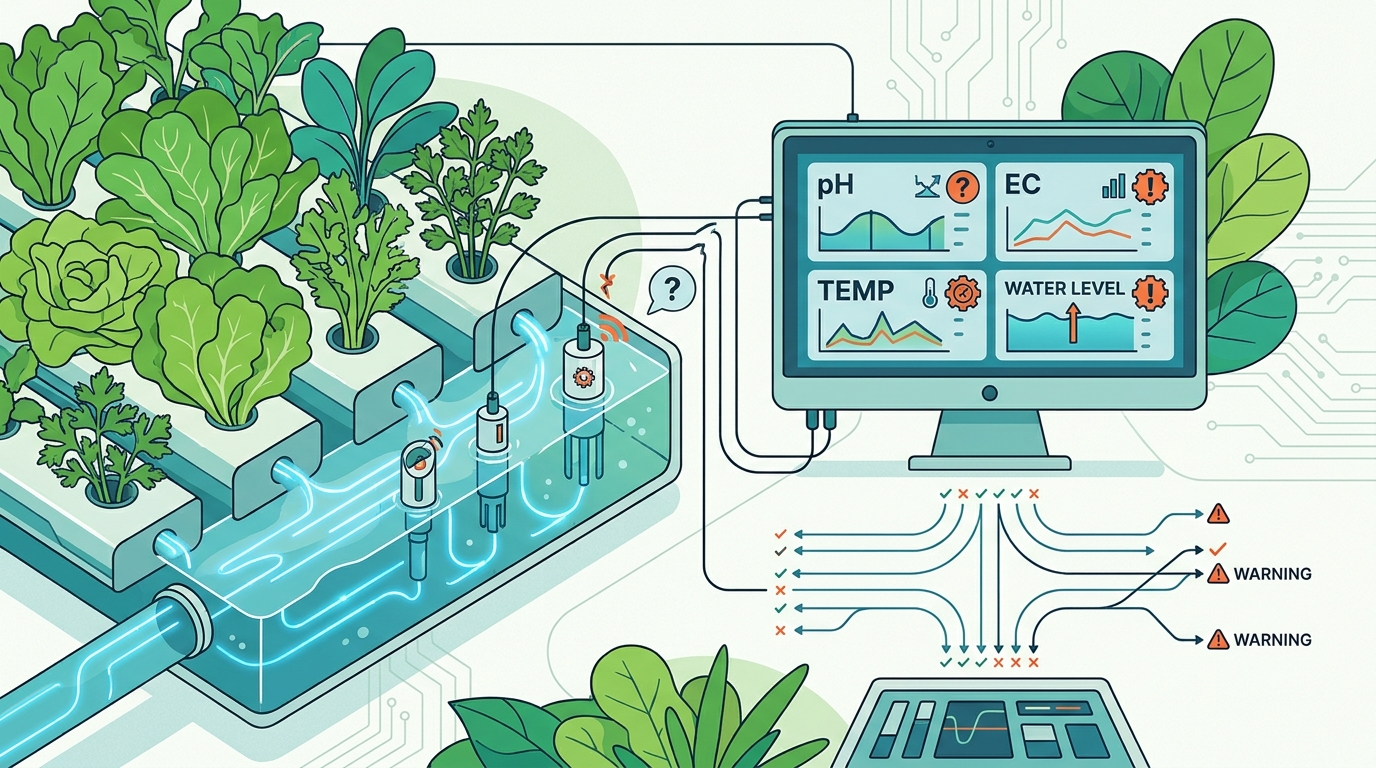
That reliability requires more than collecting measurements. It requires knowing whether those measurements deserve to be trusted.
pH probes help monitor the chemical conditions that influence nutrient availability. EC sensors provide useful information about overall ionic concentration but cannot identify individual nutrient levels. Temperature sensors reveal environmental changes that can affect root health, oxygen availability, and conductivity measurements. Each instrument has a distinct role, and each has limitations that must be understood.
Regular calibration, independent verification, careful cleaning, appropriate probe placement, and documented maintenance work together to reduce measurement uncertainty. Equally important, dosing controllers should have safeguards that prevent questionable readings from triggering unlimited corrections.
A practical maintenance strategy should therefore combine three layers of protection:
- Measurement reliability: Calibrate and verify sensors using appropriate reference standards and manufacturer-approved procedures.
- Operational protection: Set sensible dosing limits, mixing delays, abnormal-reading alarms, and safe responses to sensor failures.
- Biological confirmation: Interpret sensor data alongside root condition, plant development, nutrient formulation, and environmental observations.
When these layers work together, automation becomes a useful tool rather than an unquestioned authority. The system can respond to genuine changes without repeatedly correcting problems that exist only in its measurements.
Ultimately, consistent year-round hydroponic production depends on the quality of both the growing environment and the information used to manage it. A calibrated sensor does not guarantee a successful harvest, but an unverified sensor can undermine even the most advanced equipment. The smartest automated garden is not the one that makes the most adjustments. It is the one that knows when its measurements are trustworthy enough to act.


Comments
Post a Comment